


Enceladus and Titan are two of the best places in the solar system to look for life beyond Earth, and neither is anywhere near the Sun’s habitable zone. Enceladus has a confirmed global ocean, and its geysers carry organic molecules, hydrogen and phosphorus into space. Titan has a thick atmosphere, lakes of liquid methane and rich organic chemistry, with liquid water probably hidden deep below. No evidence of life has been found on either moon.
This guide compares the two, explains what each has and lacks, and covers the missions that will study them next.
Titan vs Enceladus at a glance
| Titan | Enceladus | |
|---|---|---|
| Width | 5,150 km | 504 km |
| Orbits | Saturn | Saturn |
| Atmosphere | Thick, mostly nitrogen with methane | Almost none |
| Surface temperature | About −179 °C | Far below freezing |
| Liquid on the surface | Methane and ethane lakes and seas | None |
| Liquid water | Likely deep inside (debated) | Global ocean confirmed |
| Organic molecules | Found | Found |
| Phosphorus | Not detected so far | Found in ice grains |
| Next mission | Dragonfly, launch 2028, arrival 2034 | None on its way yet |
Explore both moons
Pick Titan or Enceladus below, click a layer to see what lies inside, and check which ingredients for life each moon has.
Titan or Enceladus: where would life have the best chance?
Choose a moon, look inside it, and see which ingredients for life have actually been found.
Cross-sections are simplified and not to scale.
How big are they?
12,742 km
5,150 km
3,474 km
504 km
Status labels reflect published results as of 2026: Found means measured by a spacecraft, Likely means supported by evidence but debated or indirect, Not yet shown means no direct evidence. Sources: NASA on Titan, NASA on Enceladus, and the Dragonfly mission.
What is an ocean world?
An ocean world is a planet or moon with a large body of liquid water, usually hidden beneath an icy shell. Earth is the only one where the ocean is on the surface. Several moons in the outer solar system, including Jupiter’s Europa and Saturn’s Enceladus, appear to have oceans under their ice.
These moons are far from the Sun, so their water is not warmed by sunlight. Instead, the pull of the planet they orbit squeezes and flexes them, which creates heat inside. That is why ocean worlds can stay liquid outside the traditional habitable zone.
Scientists look for three basic ingredients for life as we know it: liquid water, the right chemical elements, and a source of energy. Both of Saturn’s moons score on some of these.
Titan: a hazy moon with methane lakes
Titan is Saturn’s largest moon, at 5,150 km wide, and the second largest moon in the solar system after Jupiter’s Ganymede. Christiaan Huygens discovered it in 1655. It is the only moon with a thick atmosphere.
An atmosphere like no other. Titan’s air is mostly nitrogen, like Earth’s, with a few percent methane. The pressure at the surface is about 1.5 times what we feel on Earth. An orange haze hides the surface from visible light, so spacecraft have to use radar and infrared to see through it.
A methane cycle. On Earth, water evaporates, forms clouds and falls as rain. On Titan, methane does the same. It rains, flows in rivers and collects in lakes and seas near the poles. The surface is about −179 °C, cold enough that water ice behaves like rock.
Organic chemistry. Sunlight breaks apart methane and nitrogen in the upper atmosphere, and the pieces combine into complex organic molecules that drift down to the surface. Dark organic grains pile up into dunes around Titan’s equator.
In 2005 the Huygens probe, carried to Saturn by NASA’s Cassini spacecraft, parachuted through the haze and landed on Titan. It remains the farthest landing ever made from Earth.
Is there water on Titan?
Probably, but not on the surface. Cassini’s measurements of Titan’s gravity and its changing shape point to liquid water or slush deep inside, under a thick icy crust. Scientists still debate how much of it is truly liquid, which is why it is labelled “likely” and not “confirmed” in the widget above.
If liquid water and organic material ever meet, for example after a comet strike melts the ice, Titan could host the kind of chemistry that led to life on early Earth. That idea drives NASA’s next mission there.
Dragonfly: a drone for Titan
Dragonfly is a car-sized, nuclear-powered rotorcraft with eight rotors. NASA plans to launch it in July 2028 on a SpaceX Falcon Heavy rocket and expects it to reach Titan in 2034. After landing, it should spend more than three years flying to different sites to study the surface chemistry.
Flying on Titan is easier than it sounds. The air is about four times denser than Earth’s, and gravity is only about one seventh as strong. Dragonfly will carry instruments to check what the surface is made of and whether the chemistry looks like the building blocks of life. It is a mission about habitability, not a search for living creatures.
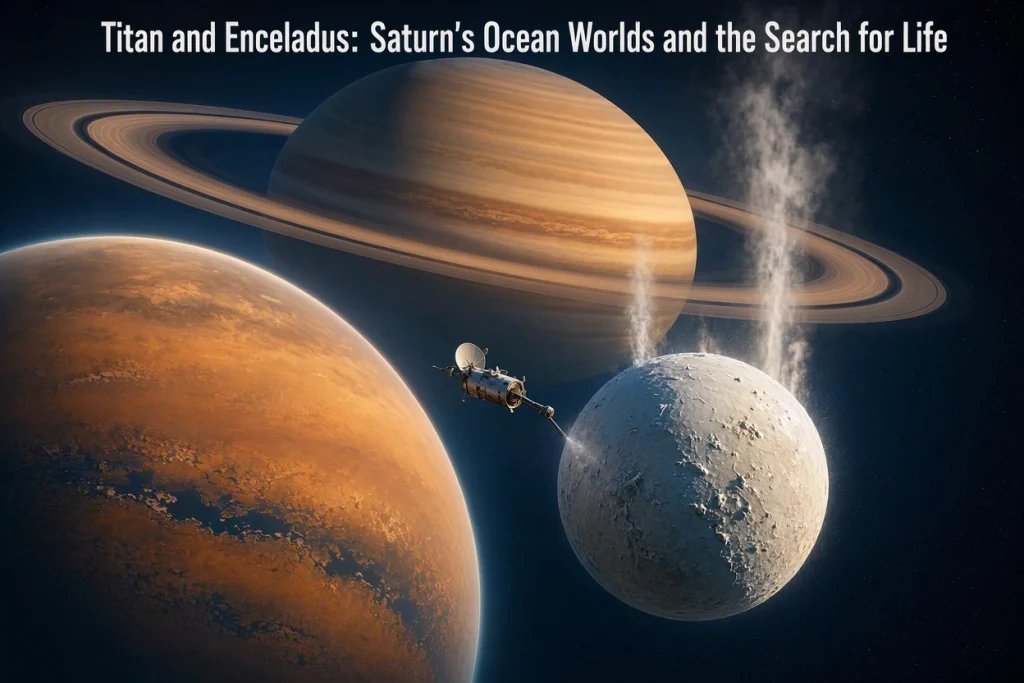
Enceladus: a tiny moon with geysers
Enceladus is small, only 504 km wide, which is roughly the distance from Dublin to London. William Herschel discovered it in 1789. For two centuries it was a bright, icy dot. Then Cassini changed that.
The geysers. In 2005, Cassini spotted jets of water vapour and ice grains erupting from long cracks near Enceladus’s south pole. These cracks are nicknamed tiger stripes. The jets feed Saturn’s E ring, which is why the E ring is so wide. You can read more in our guide to Saturn’s rings.
A global ocean. Careful measurements of a tiny wobble in the moon’s rotation showed that its icy shell floats on a liquid ocean that covers the whole moon. Cassini then flew through the plumes and tasted the ocean directly.
Hydrothermal activity. Cassini found molecular hydrogen and tiny grains of silica in the plumes. These suggest that hot water reacts with rock on the sea floor, much like hydrothermal vents on Earth. On Earth, vents support rich ecosystems, even without sunlight.
Organic molecules. The ice grains contain many organic compounds, including simple carbon-based molecules that are the ingredients for amino acids.
The phosphorus discovery
In 2023, a team led by Frank Postberg at the Freie Universität Berlin reported that Cassini’s dust analyser had found phosphates in Enceladus’s ice grains. Phosphorus is one of the six elements essential to life, and until then it had not been detected in any ocean beyond Earth. Lab tests suggested the phosphate concentration in Enceladus’s ocean could be at least 100 times higher than in Earth’s oceans.
The other five essential elements, carbon, hydrogen, nitrogen, oxygen and sulfur, had been detected earlier, so all six have now been found in material from Enceladus. The researchers were careful to add that there is no evidence the ocean is actually inhabited.
Which moon is the better place for life?
On today’s evidence, Enceladus has the stronger case. It has a confirmed ocean, a likely energy source, organic molecules and phosphorus, and its geysers hand samples to any spacecraft that passes through. No other world offers such easy access to an ocean.
Titan’s appeal is different. It is the best place to study the kind of chemistry that may have preceded life, because the chemistry is happening in the open, on the surface and in the air. Titan also raises a bigger question: could life use methane instead of water? That is only a hypothesis, and nothing has been found to support it, but it is why scientists keep studying the lakes.
A fair summary is that Enceladus is the stronger candidate for life as we know it, and Titan is the richer laboratory for how life might begin.
What missions are heading to these moons?
- Dragonfly (NASA): Launch planned for July 2028, arrival at Titan in 2034.
- Enceladus: No spacecraft is on its way. Scientists have proposed orbiters and landers that would fly through the plumes and search for signs of life, and it remains a leading target for future missions.
- Europa Clipper (NASA): Launched in 2024 and due to reach Jupiter’s moon Europa around 2030, it will help show how common habitable oceans are. Learn more in our Jupiter overview.
For comparison, we have also been searching for past life on Mars. See the search for life on Mars.
Frequently asked questions
Is there life on Enceladus?
No life has been found. Enceladus has liquid water, organic molecules, an energy source and phosphorus, so it is one of the best places to look, but no one has yet tested for living organisms.
Is there life on Titan?
No life has been found on Titan. It has rich organic chemistry and probably liquid water deep inside, but the surface is extremely cold.
Does Titan have an ocean?
Evidence suggests there is liquid water or slush deep inside Titan, but scientists still debate how much of it is liquid. The surface lakes are made of methane and ethane, not water.
What are the geysers on Enceladus made of?
Water vapour and tiny ice grains, mixed with salts, organic molecules, hydrogen and silica.
Why are Titan and Enceladus called ocean worlds?
Both appear to hide liquid water under icy crusts. The evidence is strongest for Enceladus.
When will Dragonfly reach Titan?
NASA plans to launch Dragonfly in July 2028 and expects it to arrive in 2034.
How many moons does Saturn have?
Saturn has 285 confirmed moons as of March 2026. See our full count of moons for each planet.
Key takeaways
- Enceladus has a confirmed global ocean, hydrogen, organic molecules and phosphorus.
- Titan has a thick atmosphere, methane lakes and complex organic chemistry, with water probably hidden deep inside.
- Neither moon has shown any sign of life, but both are prime targets for astrobiology.
- Dragonfly launches in 2028 and reaches Titan in 2034. No mission to Enceladus has been launched yet.
Continue exploring in our Solar System guide and our astrobiology section.