


Saturn’s rings are made mostly of water ice, in billions of pieces ranging from dust grains to house-sized chunks. They are wide but extremely thin, often only about 10 metres thick. Scientists still debate their age: some studies say they are only 100 to 400 million years old, while others argue they could date back to the early solar system. Either way, they are slowly falling into Saturn and will not last forever.
This guide covers what the rings are made of, how many there are, how they may have formed, why they seemed to disappear in 2025, and what spacecraft have taught us.
Quick facts about Saturn’s rings
| Fact | Detail |
|---|---|
| Main composition | Water ice, more than 95 percent |
| Particle size | Dust grains to chunks as big as a house |
| Typical thickness | Often about 10 metres |
| Main rings span | About 67,000 to 137,000 km from Saturn’s centre |
| Total mass | About 40 percent of the mass of Saturn’s moon Mimas |
| Estimated age | Debated: roughly 100 to 400 million years, or possibly much older |
| Expected lifetime | Perhaps 100 million to a few hundred million years more |
| Planet’s tilt | About 27 degrees, which gives us changing views of the rings |
What are Saturn’s rings made of?
The rings are not solid. Each ring is a swarm of separate pieces, all orbiting Saturn like tiny moons. Measurements from the Cassini spacecraft show that most of the material is water ice. It is mixed with small amounts of dust and rock, which is what gives some rings a darker, reddish tint.
The pieces range from grains as fine as smoke to boulders the size of a house. Together they hold about 40 percent of the mass of Mimas, one of Saturn’s smaller moons. That is tiny compared to the planet, which is why the rings are so easy to disturb.
The James Clerk Maxwell calculation of 1859 showed that the rings could not be solid sheets. Solid rings would tear apart under Saturn’s gravity, so they had to be made of many small particles. Later observations confirmed it.
How many rings does Saturn have?
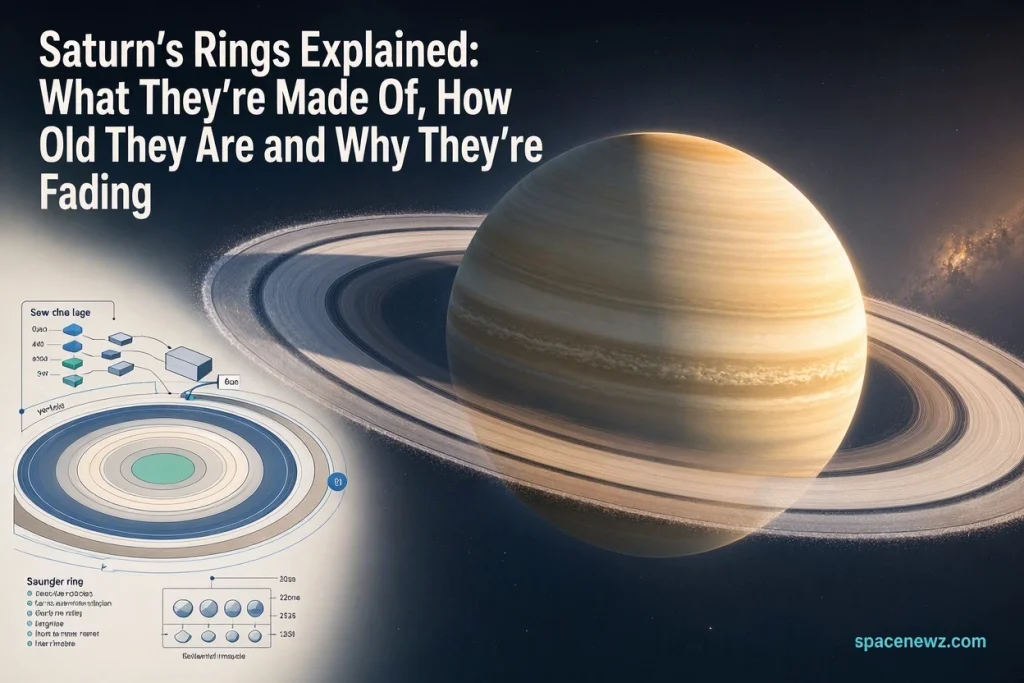
Saturn has seven main named rings, labelled with letters in the order they were discovered, not by position. Moving outward from the planet, they run in this order: D, C, B, A, F, G and E. The gap between the B and A rings is called the Cassini Division.
The widget below shows the rings and gaps to scale. Pick a ring to see where it sits and what makes it special, then drag the slider to tilt Saturn.
Saturn’s rings, ring by ring
Saturn’s rings, to scale
Select a ring, then tilt Saturn to see why the rings seemed to vanish in 2025.
Distances are measured from the centre of Saturn, whose radius is about 60,300 km. Ring letters follow the order in which the rings were discovered, not their position. Sources: NASA and the Cassini mission.
Here is what each ring is known for:
- D ring: The innermost ring is very faint. Voyager 1 found it in 1980.
- C ring: A thin, dim ring made of darker particles. Ripples in it have helped scientists study the inside of Saturn.
- B ring: The brightest and densest ring, holding most of the mass of the main rings. Dark, temporary “spokes” appear in it.
- Cassini Division: A wide gap, about 4,800 km across, between the B and A rings. Giovanni Cassini noticed it in 1675. It is not empty, because thin ringlets cross it.
- A ring: The outer main ring. The small moons Pan and Daphnis sit in gaps in it and keep them open.
- F ring: A thin, twisted ring shaped by the small moons Prometheus and Pandora.
- G ring: A faint, dusty ring with a bright arc.
- E ring: The widest ring, fed by ice from geysers on Saturn’s moon Enceladus. It reaches out about 480,000 km from the planet.
Saturn also has a huge, faint ring far beyond the others, found in 2009 using the Spitzer Space Telescope. It is tilted and made of dust from the moon Phoebe.
Saturn’s many moons shape the rings. See how many there are in our guide to how many moons each planet has.
How thin are Saturn’s rings?
The main rings stretch for tens of thousands of kilometres but are often only about 10 metres thick. If you made a scale model of the rings as wide as a football field, they would be thinner than a sheet of paper.
This is why the rings seem to vanish when we see them edge-on, as explained below.
How did Saturn’s rings form?
Nobody knows for sure. There are two main ideas.
The rings are young. They could be debris from a small moon or a comet that strayed too close to Saturn and was torn apart by its gravity. In this version, the rings formed within the last few hundred million years.
The rings are old. They could have formed early in the history of the solar system, around the time Saturn itself formed, about 4.5 billion years ago.
Because Saturn’s rings are so clean and bright, many scientists think they are young. Ice exposed to space slowly gets covered by dark dust from comets and meteoroids, and Saturn’s rings look much cleaner than they would after billions of years.
However, a team of researchers has argued that the rings only appear young. Their idea is that dusty and organic material is lost from the rings over time, which makes them look cleaner than their true age would suggest. The question is still open.
Are Saturn’s rings disappearing?
Yes, slowly. Material is falling out of the rings and into Saturn in a process called ring rain.
Sunlight and tiny impacts electrically charge small icy grains. Saturn’s magnetic field then pulls these grains down into the planet’s atmosphere. Cassini measured this directly in 2017. Its Grand Finale mission sent it through the gap between the rings and the planet 22 times, and it collected material falling from the rings. One result suggested about 600 kg of silicate grains fall into Saturn every second.
At that rate, the rings could last somewhere between 100 million and a few hundred million years. That is a short time compared with the age of the planet. It also means we are lucky to be around while Saturn has such a spectacular set of rings. Collisions between moons, comets or asteroids could add fresh material, so the exact end date is uncertain.
Why did Saturn’s rings seem to disappear in 2025?
Saturn is tilted by about 27 degrees, and its rings are tilted with it. As Saturn travels around the Sun, which takes about 29 Earth years, our view of the rings changes. Twice in each orbit, about every 13 to 15 years, Earth passes through the plane of the rings and we see them exactly edge-on.
That happened in 2025. Because the rings are so thin, they almost vanished from backyard telescopes. They did not actually go anywhere. We were simply looking at them from the side.
After the edge-on moment, the rings slowly open up again. They should reach their widest tilt toward Earth around 2032. You can try this yourself in the widget above by moving the viewing angle to 0 degrees.
How did spacecraft and scientists study the rings?
Observations of Saturn’s rings go back more than four centuries.
- 1610: Galileo sees strange “ears” on either side of Saturn through an early telescope but cannot tell what they are.
- 1655 to 1659: Christiaan Huygens works out that Saturn has a thin, flat ring around it.
- 1675: Giovanni Cassini notices the dark gap that now bears his name.
- 1859: James Clerk Maxwell shows the rings must be made of many small particles.
- 1979: Pioneer 11 makes the first spacecraft flyby of Saturn.
- 1980 and 1981: Voyager 1 and Voyager 2 reveal many more ringlets and the mysterious spokes. Read about the Voyagers in Voyager spacecraft: still flying.
- 2004 to 2017: The Cassini spacecraft orbits Saturn for 13 years, then ends its mission by plunging into the planet in September 2017.
Cassini’s detailed measurements of the ring mass and composition remain the basis for most of what we know today.
Do other planets have rings?
Yes. Jupiter, Uranus and Neptune all have ring systems too. They are much fainter and darker than Saturn’s, and they are mostly made of dust and dark particles. Uranus has 13 known rings. None of them compares to Saturn’s bright, icy rings.
To see how the rings fit into the bigger picture, read our full Solar System guide.
Can you see Saturn’s rings with a telescope?
Yes. A small telescope is enough to see the rings as a separate band around the planet. Under good conditions, you may also be able to see the Cassini Division. How well you see the rings depends on their tilt. They were nearly invisible in 2025 and are opening up each year toward 2032.
Saturn’s moon Enceladus, which feeds the E ring, is also one of the most interesting places to look for signs of life beyond Earth. Learn more in our astrobiology section.
Frequently asked questions
What are Saturn’s rings made of?
Mostly water ice, with a small amount of dust and rock. The pieces range from tiny grains to boulders as big as a house.
How many rings does Saturn have?
Saturn has seven main rings, labelled D, C, B, A, F, G and E, plus a very large, faint ring discovered in 2009. The Cassini Division is a gap between two of them.
How old are Saturn’s rings?
Scientists disagree. Some studies suggest 100 to 400 million years, while others say the rings could be as old as Saturn itself.
Are Saturn’s rings disappearing?
Yes. Material is slowly falling into Saturn as ring rain, and the rings could last 100 million to a few hundred million more years.
Why did Saturn’s rings vanish in 2025?
Earth passed through the plane of the rings in 2025, so we saw them edge-on. They are so thin that they almost disappeared from view.
How thick are Saturn’s rings?
Often only about 10 metres, even though they stretch for tens of thousands of kilometres.
Which spacecraft visited Saturn’s rings?
Pioneer 11 in 1979, Voyager 1 and 2 in 1980 and 1981, and Cassini from 2004 to 2017.
Key takeaways
- Saturn’s rings are mostly water ice and extremely thin.
- There are seven main rings (D, C, B, A, F, G, E) and a gap called the Cassini Division.
- Their age is debated, and they are slowly falling into Saturn.
- They seemed to disappear in 2025 because we saw them edge-on.
- Cassini gave us most of our detailed knowledge of the rings.
Continue exploring in our Solar System guide : Pillar link: The Solar System (/the-solar-system/)