


Pillar Page Guide: The Solar System: Planets, Moons, and Features of Our Solar Neighborhood
Introduction
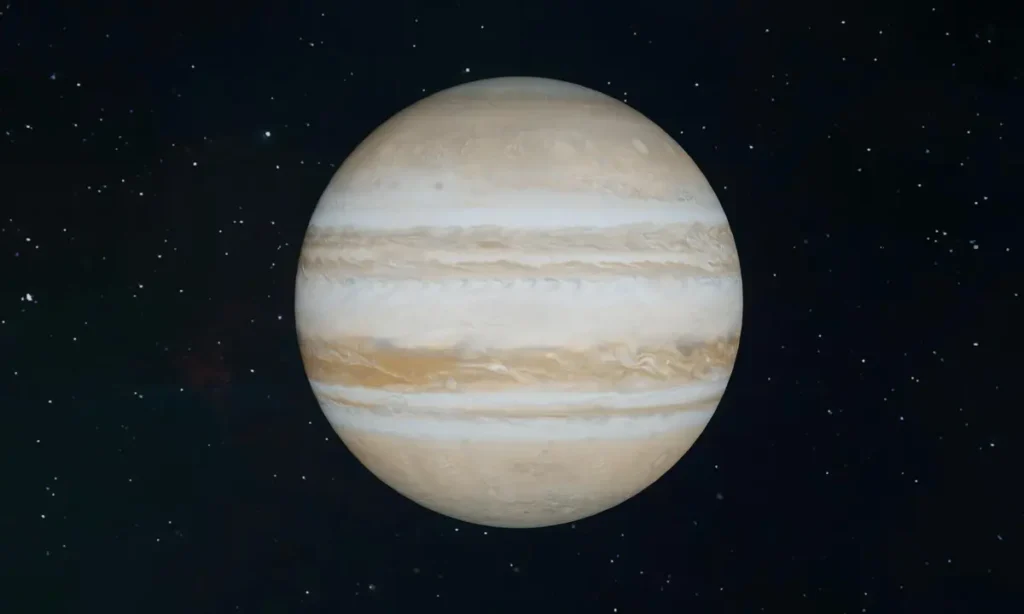
High in Jupiter’s southern hemisphere swirls a storm so massive it could swallow Earth whole. The Great Red Spot, an anticyclonic vortex larger than our entire planet, has raged for at least 350 years and possibly much longer. This colossal storm represents one of the solar system’s most iconic features and a window into the extreme meteorology of gas giant planets.
Unlike hurricanes on Earth that last days or weeks before dissipating, Jupiter’s Great Red Spot has persisted for centuries. This longevity, combined with its enormous size and distinctive color, has fascinated astronomers since its discovery. Understanding what drives and sustains this storm reveals fundamental insights into atmospheric dynamics, planetary physics, and the alien weather systems of worlds vastly different from our own.
Discovery and Historical Observations
The Great Red Spot was first definitively observed in 1831 by Samuel Heinrich Schwabe, though earlier observations by Giovanni Cassini in 1665 may have captured the same feature. For over a century and a half, astronomers have tracked the spot’s size, color, and position, creating one of the longest continuous observational records in astronomy.
Historical records show significant changes over time. In the late 1800s, the spot measured roughly 25,000 miles wide—large enough to fit three Earths side by side. More recent observations reveal substantial shrinking. By 2014, the spot measured just 10,000 miles across, less than half its historical maximum. This dramatic size reduction raises questions about the storm’s future and the forces governing its evolution.
Color variations have also been documented. While usually appearing reddish-orange (hence its name), the spot occasionally fades to a paler hue before regaining its distinctive color. These changes likely reflect variations in the chemical composition of materials brought up from deeper in Jupiter’s atmosphere, though the exact chemistry remains debated.
What Powers the Storm
The Great Red Spot is an anticyclone—a high-pressure region where winds rotate counterclockwise in the southern hemisphere (opposite to hurricanes on Earth). Wind speeds at its edges reach 270-425 mph, faster than Earth’s strongest tornadoes. Despite these violent winds, the storm itself drifts slowly westward relative to Jupiter’s clouds, completing a circuit around the planet roughly every six days.
Unlike Earth hurricanes that draw energy from warm ocean waters, the Great Red Spot is powered by Jupiter’s internal heat and the planet’s rapid rotation. Jupiter radiates more energy into space than it receives from the Sun, with internal heat generated by gravitational contraction and possibly residual heat from the planet’s formation 4.6 billion years ago. This heat drives convection that powers atmospheric dynamics.
Jupiter’s rapid 10-hour rotation creates powerful Coriolis forces that help organize and maintain large-scale atmospheric structures. The spot sits between two jet streams flowing in opposite directions—this shear may help confine and sustain the vortex. Computer simulations suggest that smaller storms occasionally merge with the Great Red Spot, possibly feeding it energy and extending its lifetime.
The Mystery of Its Color
The Great Red Spot’s distinctive color has puzzled scientists for decades. The reddish-brown hue doesn’t match Jupiter’s dominant tan and white cloud bands, suggesting unique chemistry occurs within the storm. Several theories attempt to explain this coloration, though none has been definitively proven.
One hypothesis proposes that ultraviolet sunlight triggers chemical reactions in ammonia and acetylene high in Jupiter’s atmosphere, creating complex organic compounds called tholins. These reddish compounds form through photochemistry—the same process that gives Saturn’s moon Titan its orange haze. Laboratory experiments show that exposing Jupiter-like atmospheres to UV radiation produces red-brown materials similar to the spot’s color.
Alternative theories suggest the color comes from phosphorus compounds or sulfur brought up from Jupiter’s deep atmosphere. The Great Red Spot extends deeper into the atmosphere than surrounding clouds, potentially dredging up materials from depths where different chemistry occurs. Recent observations by NASA’s Juno spacecraft, which can probe beneath the cloud tops, may help resolve this long-standing mystery.
Structure and Depth
The storm isn’t just a surface feature—it extends deep into Jupiter’s atmosphere. Juno’s microwave instrument, which can see below the clouds, revealed that the Great Red Spot penetrates at least 200-300 miles down, far deeper than expected. This depth helps explain the storm’s longevity and the tremendous energy it contains.
At the surface, the spot appears as a raised feature, with cloud tops about 5 miles higher than surrounding regions. This elevation difference reflects the high-pressure nature of the anticyclone—air rises in the center, cools, condenses into clouds (creating the visible structure), then descends around the edges. This circulation pattern resembles high-pressure systems on Earth, but on a vastly larger scale.
Temperature measurements show the spot’s center is warmer than its surroundings. Infrared observations detect heat radiating from the storm’s core, with temperatures several degrees warmer than adjacent regions. This warmth drives the upward motion that maintains the cloud structure and powers the circulation.
Why Is It Shrinking?
The Great Red Spot’s shrinking has accelerated in recent decades. Between 1995 and 2020, it contracted from about 13,000 miles wide to roughly 10,000 miles—a 23% reduction in just 25 years. At this rate, some astronomers speculated the storm might eventually disappear, though recent observations suggest the shrinkage may be slowing.
Several factors might explain this contraction. Changes in Jupiter’s internal heat flow could reduce the energy available to power the storm. Interactions with jet streams and smaller storms might be draining energy. Climate shifts in Jupiter’s atmosphere—analogous to changing ocean currents on Earth—could be altering the conditions that sustain the vortex.
However, the shrinking spot is also becoming taller and more circular, suggesting reorganization rather than simple decay. The storm may be entering a new equilibrium state with different dimensions but continued stability. Long-term monitoring will reveal whether this represents temporary fluctuation or permanent transformation.
Comparison to Other Jovian Storms
The Great Red Spot isn’t Jupiter’s only massive storm, though it is the largest and longest-lived. Oval BA, nicknamed ‘Red Spot Junior,’ formed in 2000 when three smaller white ovals merged. Initially white, it turned reddish in 2006, suggesting similar atmospheric chemistry to the Great Red Spot. Oval BA is about half the size of its larger cousin but demonstrates that Jupiter can generate new large storms.
Numerous smaller anticyclones and cyclones pepper Jupiter’s atmosphere, appearing as white or brown ovals. These storms typically last years to decades before dissipating or merging with other features. The fact that they eventually fade while the Great Red Spot persists suggests something special about the giant storm’s size, location, or energy sources that enables its exceptional longevity.
Jupiter’s poles, revealed in stunning detail by Juno, host clusters of cyclones arranged in geometric patterns—eight cyclones surrounding one central cyclone at the north pole, and five surrounding one at the south. These polar storms differ from the Great Red Spot in structure and possibly mechanism, demonstrating the diversity of atmospheric phenomena on gas giants.
Studying the Storm with Spacecraft
Every spacecraft visiting Jupiter has studied the Great Red Spot. Pioneer 10 and 11 (1973-1974) provided the first close-up images. Voyager 1 and 2 (1979) captured detailed views revealing complex structure and motion. The Galileo orbiter (1995-2003) monitored the storm for years, documenting changes in size and color.
The Hubble Space Telescope has observed the spot regularly since the 1990s, creating a long-term record of its evolution. These observations show not only the shrinking but also fluctuations in color intensity and small-scale structures within the storm. Hubble’s sharp resolution reveals waves and ripples in the cloud tops that provide clues about atmospheric dynamics.
NASA’s Juno spacecraft, in orbit since 2016, studies the spot with unprecedented detail. Juno flies just 2,200 miles above Jupiter’s cloud tops during close passes, capturing images with resolution down to 3 miles per pixel. Its suite of instruments measures magnetic fields, gravity, composition, and subsurface structure, providing the most complete picture yet of this iconic storm and the planet that hosts it.
What We’ve Learned
Studying the Great Red Spot has taught us fundamental lessons about atmospheric dynamics on giant planets. We’ve learned that storms on worlds without solid surfaces can persist far longer than those on Earth, where friction with the ground dissipates energy. We’ve discovered that internal planetary heat can power weather systems as effectively as stellar radiation.
The spot demonstrates how rotation and atmospheric shear can organize turbulent flows into stable, long-lived structures. This insight applies beyond Jupiter—helping us understand atmospheric dynamics on Saturn, Neptune, and even exoplanets around other stars. The mechanisms that create and sustain the Great Red Spot likely operate wherever there are thick atmospheres and rapid rotation.
Perhaps most importantly, the Great Red Spot reminds us that planetary atmospheres are dynamic, evolving systems. Even features that have persisted for centuries are not eternal. Understanding what governs their formation, evolution, and eventual fate helps us appreciate the complex, ever-changing nature of worlds beyond Earth.
The Future of the Great Red Spot
Will the Great Red Spot disappear? Current data provides no clear answer. If shrinking continues, the storm could become small enough that interactions with Jupiter’s jet streams destabilize it, causing rapid dissipation. Alternatively, it might stabilize at a smaller size, persisting indefinitely in its new configuration.
Some scientists speculate that even if the current spot disappears, atmospheric conditions might generate a new anticyclone in the same region. Jupiter’s internal heat and rapid rotation—the fundamental drivers of atmospheric circulation—aren’t changing. The specific storm we call the Great Red Spot might be temporary, but the atmospheric dynamics that create such features are likely permanent.
Continued monitoring by spacecraft and Earth-based telescopes will track the storm’s evolution over coming decades. Future missions might deploy atmospheric probes into the storm itself, directly sampling its composition and measuring wind speeds, temperatures, and pressure at various depths. Such measurements would provide unprecedented insight into one of the solar system’s most spectacular meteorological phenomena.
Conclusion
The Great Red Spot stands as a testament to the incredible scale and longevity possible in planetary atmospheres. A storm larger than Earth, raging for centuries, powered by internal planetary heat and organized by rotation—it represents weather unlike anything we experience on our world. Yet studying it helps us understand atmospheric physics with applications from Earth’s own weather to distant exoplanets.
As we continue observing this iconic feature, we’re witnessing planetary evolution in action. Whether the storm shrinks further, stabilizes, or undergoes unexpected transformations, each change teaches us about the forces shaping giant planets. The Great Red Spot may not be eternal, but it has certainly earned its place as one of the solar system’s most famous and scientifically valuable features.
Future generations may look back at our era as the time when the Great Red Spot began its transformation or even disappearance. Or they may marvel that we worried unnecessarily about a feature that will outlast human civilization. Either way, this massive storm reminds us that the cosmos is full of wonders that dwarf our human scales—and that there is still so much to discover in our own cosmic neighborhood.
Related Articles
• Jupiter: King of the Planets
• The Galilean Moons: Jupiter’s Fascinating Satellites
• Gas Giants vs Rocky Planets: Understanding Planetary Types
• Return to main article: The Solar System: Planets, Moons, and Features of Our Solar Neighborhood